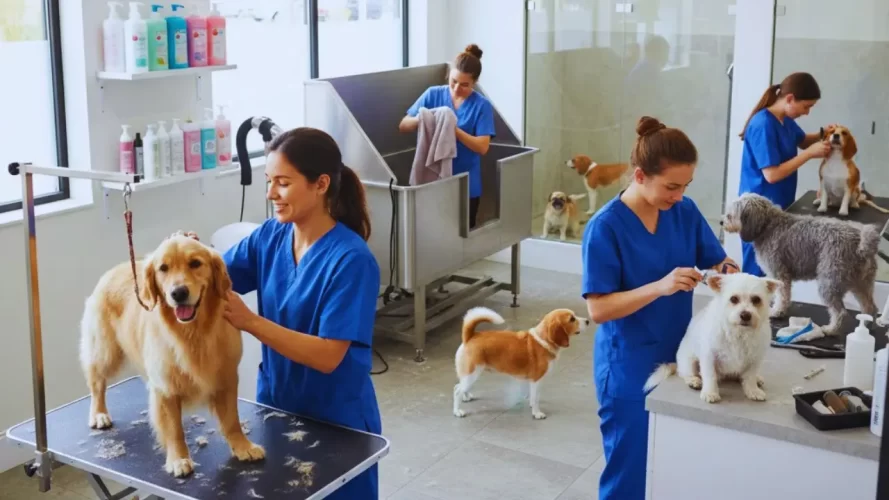
A dog grooming course begins with understanding essential tools like brushes, clippers, and grooming tables. It then teaches basic grooming techniques including bathing, drying, and nail trimming dog grooming class. Next, trainees learn breed-specific styles to tailor care according to coat types and breed standards. Advanced lessons cover complex clipping methods and creative styling. Emphasis is also placed on handling diverse coat textures and dog temperaments to guarantee safe, effective grooming. Further insights reveal how these skills integrate professionally.

Understanding Essential Grooming Tools and Equipment
A thorough knowledge of grooming tools and equipment is fundamental for anyone pursuing dog grooming. Essential tools include brushes, combs, clippers, and scissors, each designed for specific coat types and grooming needs.
Brushes vary from slicker to bristle, aiding in detangling and removing loose hair. Clippers come with different blade sizes, allowing precise trimming and shaping cosmos pet universe. Proper tool selection guarantees efficiency and safety, minimizing stress for both groomer and dog.
Understanding equipment maintenance, such as blade sharpening and cleaning, extends tool lifespan and performance. Knowledge of grooming tables, dryers, and restraints also contributes to a controlled and comfortable grooming environment.
Mastery of these essentials empowers groomers to work independently, fostering confidence and creative freedom in their craft.
Mastering Basic Grooming Techniques
Numerous fundamental grooming techniques form the foundation of effective dog care. Mastery of these basics enables groomers to maintain cleanliness, comfort, and health for dogs of all sizes and coat types.
Core skills include brushing to remove loose hair and dirt, bathing with suitable shampoos, drying efficiently, and safely trimming nails. Each technique emphasizes gentle handling to minimize stress and guarantee cooperation.
Proper ear cleaning and checking for skin issues are also essential components. Developing consistency and confidence in these tasks grants groomers the freedom to work independently and adapt to individual dog needs.
Mastery of these foundational techniques serves as a vital stepping stone before progressing to more specialized grooming styles and advanced practices.
Learning Breed-Specific Grooming Styles
When shifting from basic grooming skills, understanding breed-specific grooming styles becomes essential. Each dog breed carries unique coat textures, growth patterns, and traditional grooming standards that demand tailored techniques.
Training focuses on recognizing these distinctions to deliver precise, respectful care that honors breed heritage. Students learn to identify key features such as the Schnauzer’s wiry coat, the Poodle’s curly fur, or the Shih Tzu’s long, flowing hair, adapting tools and methods accordingly.
This phase encourages mastery of style variety while fostering adaptability and attention to detail. Embracing breed-specific grooming not only enhances professional competence but also offers the freedom to customize looks that suit individual dogs, ensuring comfort and aesthetic integrity without compromising their natural characteristics.
Advanced Clipping and Styling Methods
Building on breed-specific techniques, advanced clipping and styling methods refine the ability to shape and sculpt a dog’s coat with greater precision and creativity.
These methods introduce the use of specialized tools, such as thinning shears and texturizing blades, allowing for nuanced adjustments to coat length and volume. Groomers learn to blend lines smoothly, create dimensional effects, and enhance a dog’s natural features without compromising comfort.
This stage emphasizes developing an artistic eye and steady hand to execute complex patterns and styles. The training encourages experimentation within professional standards, enabling groomers to express individuality while honoring each dog’s unique form.
Mastery of these techniques expands the groomer’s versatility, opening pathways to customized looks that balance functionality with aesthetic appeal.
Handling Different Coat Types and Temperaments
Effective dog grooming requires a thorough understanding of various coat types and individual temperaments. Different coats—such as double, curly, wiry, or smooth—demand specific tools and techniques to maintain health and appearance.
Groomers must adapt their approach to each coat’s texture, length, and density. Additionally, recognizing a dog’s temperament is vital for ensuring safety and effectiveness. Calm handling techniques suit relaxed dogs, while gentle restraint and patience are necessary for anxious or energetic animals.
Training emphasizes reading behavioral cues and adjusting methods accordingly, promoting a stress-free experience. Mastery in managing both coat diversity and temperament fosters confidence and skill, allowing groomers to work freely and efficiently across a wide range of dogs, ultimately enhancing the grooming process for all involved.
Conclusion
A dog grooming course systematically develops skills from fundamental tools and techniques to advanced styling and breed-specific methods. Trainees gain extensive knowledge of handling various coat types and temperaments, ensuring adaptability and professionalism. This structured progression equips learners to confidently meet diverse grooming needs, fostering both technical proficiency and animal care awareness. Ultimately, the course prepares individuals for successful careers in dog grooming through a balanced blend of theory and practical experience.